presentations
Meeting Seating
What's wrong with straight rows and front-facing chairs? Plenty. EXHIBITOR tapped industry veteran Liz Lathan, CMP, to reveal some straight-laced issues and offer easy-to-implement, curve-conscious alternatives. By Linda Armstrong
When it comes to theater-style presentations — whether they're held in an exhibit, an event space, or an auditorium — chair arrangements are paramount. Although positioning seats within your footprint might seem as mundane as loading a dishwasher, the location and direction of the chairs have a profound effect on both the presentation's effectiveness and the audience's experience.
To provide insights about theater-style seating arrangements, EXHIBITOR spoke with Liz Lathan, CMP, co-founder and chief community officer at The Community Factory. As someone who has built a business around creating and driving engagement for exhibit and corporate event clients, Lathan has a plethora of been-there, arranged-that insight on theater-style seating. Here, she provides a solid case for curves and straight-shooter warnings against straight-line seating configurations.
Why Straight-Line
Seating Must Die
Lathan says there are five Cs to effective attendee engagement: care, collaboration, co-creation, conversation, and connection. Straight-line rows and front-facing chairs — as opposed to curved rows and chairs angled toward the presenter — detract from nearly all of these five Cs. Lathan provides the following key reasons why straight rows and straight-on chairs hinder engagement.
 Audience Discomfort.
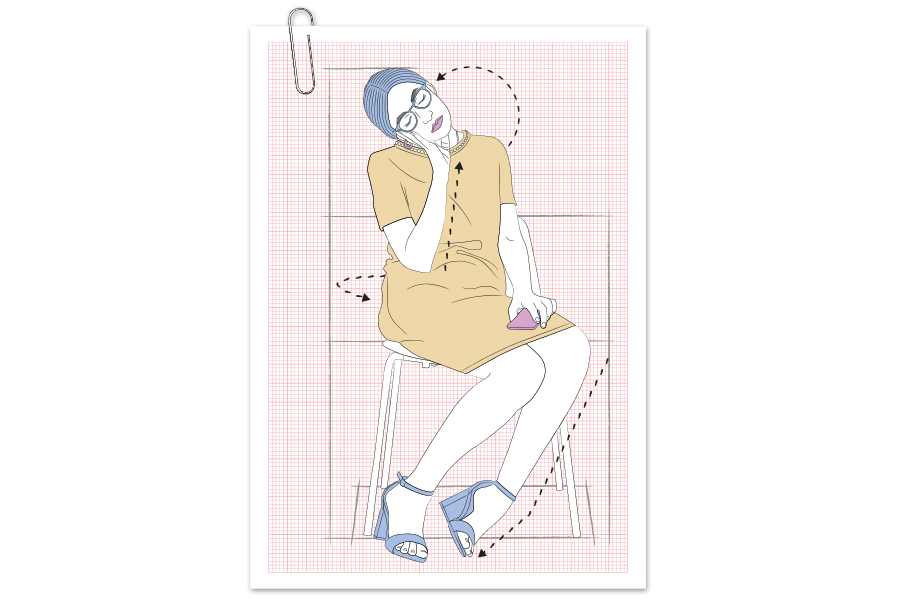
When seats are in straight rows and chairs face the front wall as opposed to the presenter, most audience members must crane their necks to view the presentation. Once they tire of this positioning (after roughly 10 minutes) they tune out the presenter. In a curved-row configuration with chairs angled toward the presenter, there's no required head turning or body repositioning, which ultimately aids in and increases audience engagement.
Hindered Connections and Collaboration.
In a straight-line setup, attendees can only see the back of people's heads in front of them and the sides of the faces of those next to them. Curved rows and angled chairs allow audience members to view the faces of at least some of the people around them. This perspective allows guests to gauge reactions, witness engagement, and even pose questions to other people (if appropriate). Even if attendees never interact with each other, this face-to-face perspective transforms a one-person show into a community experience.
Hearing Difficulties.
When people face the presenter via curved rows and chair positioning, both ears have an equal opportunity to take in the content. This is particularly important for those with impaired hearing, but it also supports one of Lathan's five Cs: care. Providing seating that allows people to sit comfortably and hear the presentation without straining subtly demonstrates that you care for your audience.
Lathan says there are five Cs to effective attendee engagement: care, collaboration, co-creation, conversation, and connection. Straight-line rows and front-facing chairs — as opposed to curved rows and chairs angled toward the presenter — detract from nearly all of these five Cs. Lathan provides the following key reasons why straight rows and straight-on chairs hinder engagement.
Audience Discomfort.When seats are in straight rows and chairs face the front wall as opposed to the presenter, most audience members must crane their necks to view the presentation. Once they tire of this positioning (after roughly 10 minutes) they tune out the presenter. In a curved-row configuration with chairs angled toward the presenter, there's no required head turning or body repositioning, which ultimately aids in and increases audience engagement.
Hindered Connections and Collaboration.In a straight-line setup, attendees can only see the back of people's heads in front of them and the sides of the faces of those next to them. Curved rows and angled chairs allow audience members to view the faces of at least some of the people around them. This perspective allows guests to gauge reactions, witness engagement, and even pose questions to other people (if appropriate). Even if attendees never interact with each other, this face-to-face perspective transforms a one-person show into a community experience.
Hearing Difficulties.When people face the presenter via curved rows and chair positioning, both ears have an equal opportunity to take in the content. This is particularly important for those with impaired hearing, but it also supports one of Lathan's five Cs: care. Providing seating that allows people to sit comfortably and hear the presentation without straining subtly demonstrates that you care for your audience.
Ways to Work Your Curves
Effective seating arrangements for lecture halls, theater productions, and orchestra halls all employ curved rows and angled chairs for a reason. The strategy works! Instead of relying on standard set-it-and-forget-it straight rows and aisles, consider an outside-the-box arrangement. Lathan offers several design options to help you effectively implement curved rows and angled chairs.
 Curve All Rows Toward the Stage.
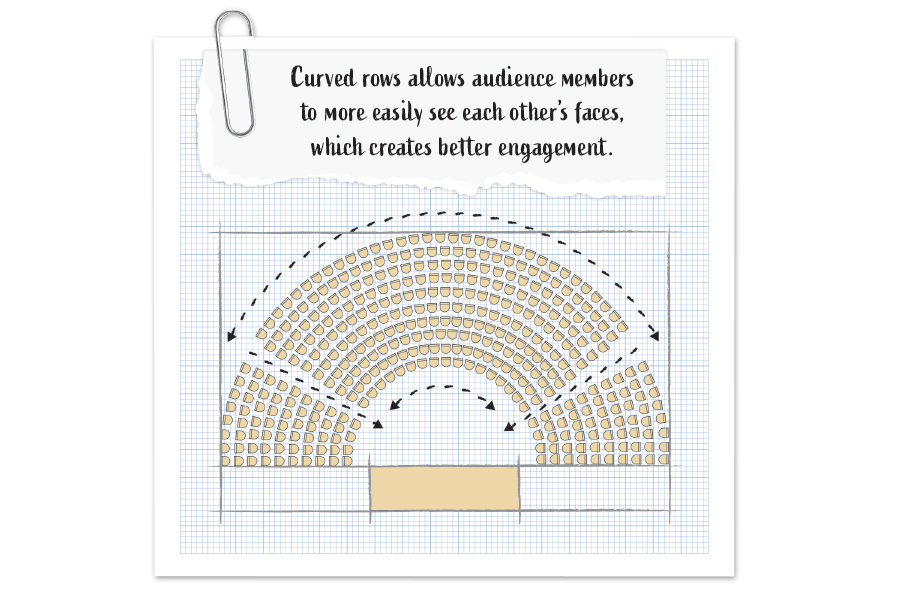
Rather than positioning rows in straight lines, which causes the aforementioned neck strain and hinders collaboration, curve the rows into elongated C shapes in front of the stage.
Face Each Chair Toward Center Stage.
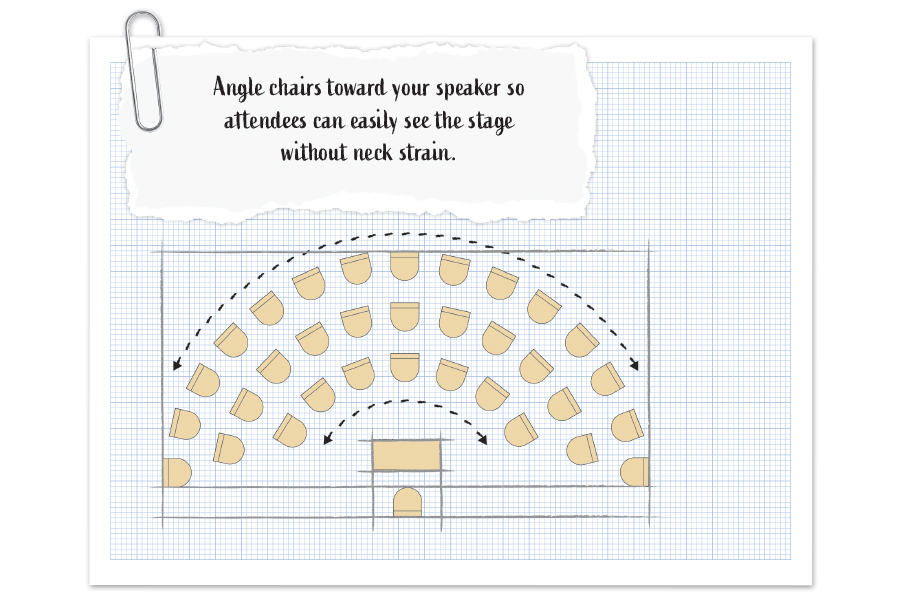
To further face-to-face engagement with the presenter and among attendees, angle individual chairs toward the stage. The farther chairs are from the center of the stage, the more each seat should be angled to provide a direct view of the speaker.
Set to the Longest Wall.
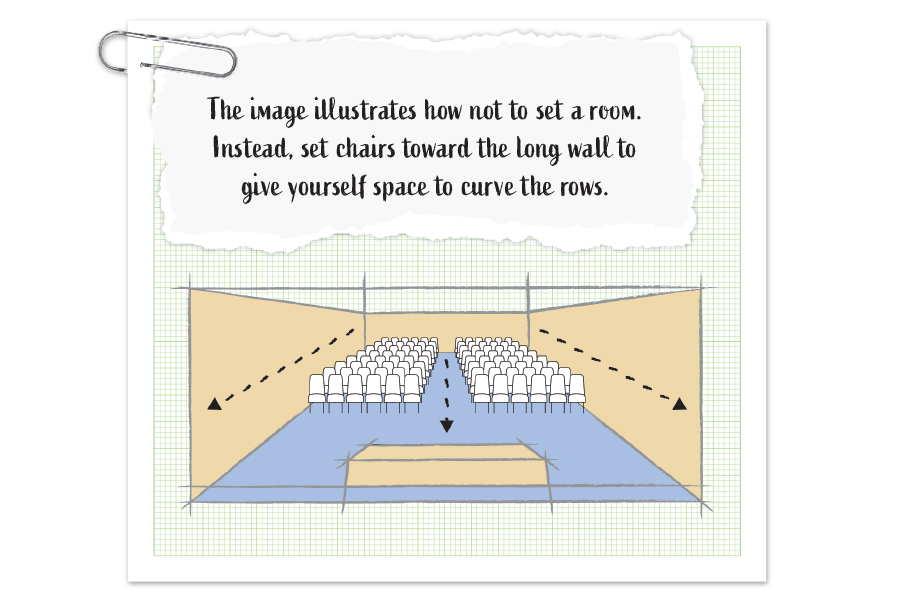
Many venues automatically set a rectangular room with straight rows of chairs facing the stage set along one of the shorter walls. This configuration prevents you from providing an adequate curve in the rows and significantly limits visibility and hearing for those in the cheap seats. The better option is to set the room so the stage is situated along one of the room's longer walls, which allows you to effortlessly curve the rows and turn the chairs for the best visibility.
Eliminate the Center Aisle.
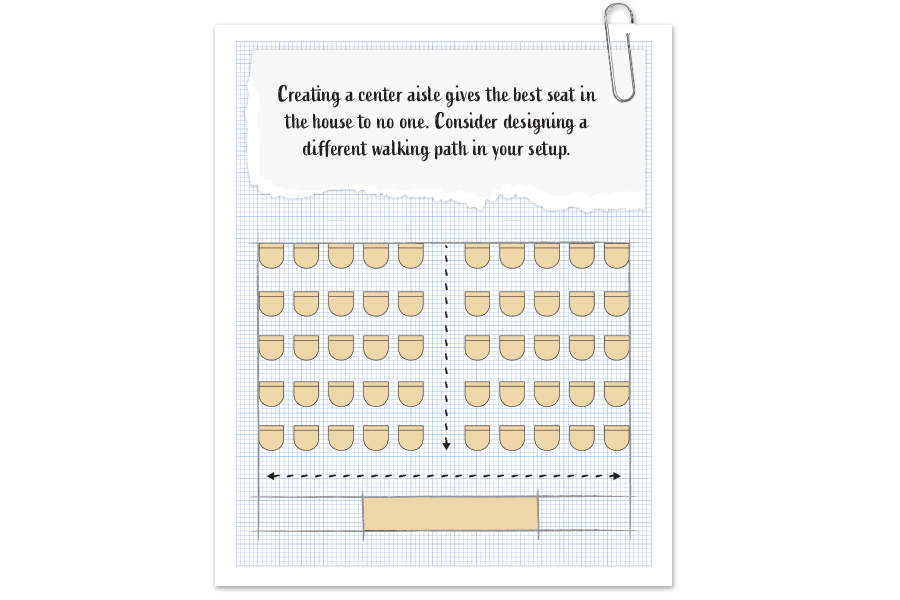
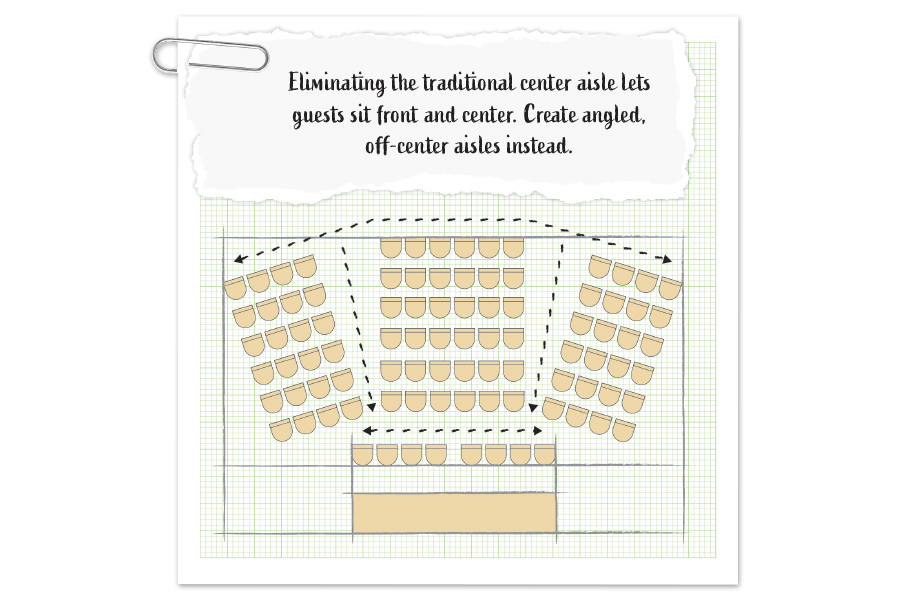
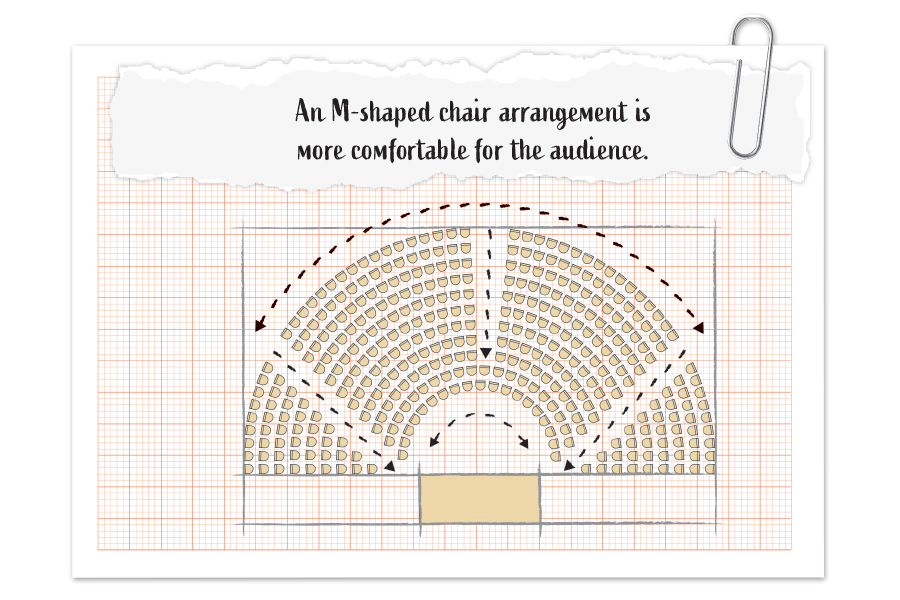
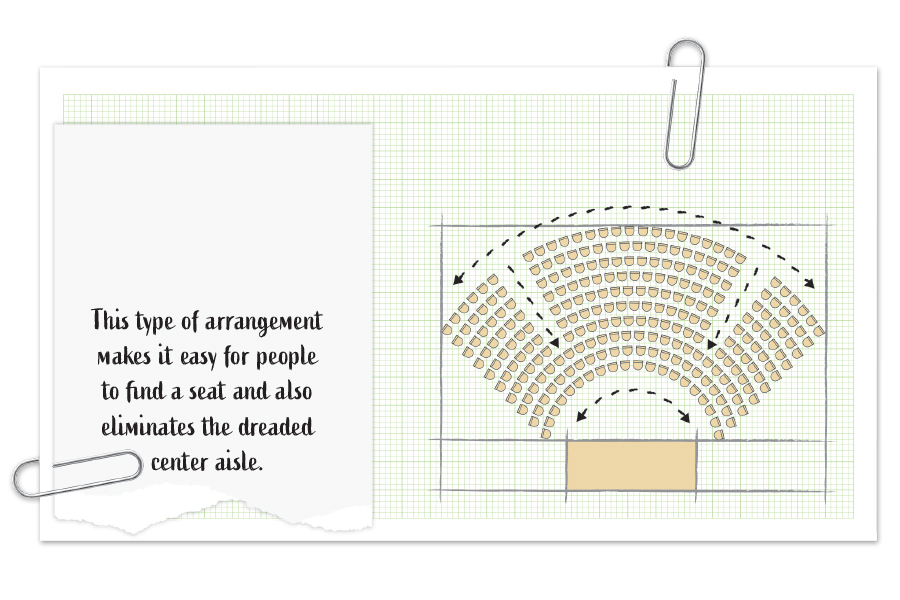
When it comes to visibility, auditory perception, and audience engagement, the best seats are dead center in the front row. But most theater-style seating runs an aisle smack down the middle — effectively killing the best seats in the house. Instead, divide seating into three or more sections and position aisles left and right of center. Or create an M shape out of the seating. Here, you'd have several interrupted horizontal rows across the front, with two (or more) access aisles cut into the back of the seating.
Hearing Difficulties.
When people face the presenter via curved rows and chair positioning, both ears have an equal opportunity to take in the content. This is particularly important for those with impaired hearing, but it also supports one of Lathan's five Cs: care. Providing seating that allows people to sit comfortably and hear the presentation without straining subtly demonstrates that you care for your audience.
Effective seating arrangements for lecture halls, theater productions, and orchestra halls all employ curved rows and angled chairs for a reason. The strategy works! Instead of relying on standard set-it-and-forget-it straight rows and aisles, consider an outside-the-box arrangement. Lathan offers several design options to help you effectively implement curved rows and angled chairs.
Curve All Rows Toward the Stage.Rather than positioning rows in straight lines, which causes the aforementioned neck strain and hinders collaboration, curve the rows into elongated C shapes in front of the stage.
Face Each Chair Toward Center Stage.To further face-to-face engagement with the presenter and among attendees, angle individual chairs toward the stage. The farther chairs are from the center of the stage, the more each seat should be angled to provide a direct view of the speaker.
Set to the Longest Wall. Many venues automatically set a rectangular room with straight rows of chairs facing the stage set along one of the shorter walls. This configuration prevents you from providing an adequate curve in the rows and significantly limits visibility and hearing for those in the cheap seats. The better option is to set the room so the stage is situated along one of the room's longer walls, which allows you to effortlessly curve the rows and turn the chairs for the best visibility.
Eliminate the Center Aisle.When it comes to visibility, auditory perception, and audience engagement, the best seats are dead center in the front row. But most theater-style seating runs an aisle smack down the middle — effectively killing the best seats in the house. Instead, divide seating into three or more sections and position aisles left and right of center. Or create an M shape out of the seating. Here, you'd have several interrupted horizontal rows across the front, with two (or more) access aisles cut into the back of the seating.
Hearing Difficulties.When people face the presenter via curved rows and chair positioning, both ears have an equal opportunity to take in the content. This is particularly important for those with impaired hearing, but it also supports one of Lathan's five Cs: care. Providing seating that allows people to sit comfortably and hear the presentation without straining subtly demonstrates that you care for your audience.
CLOSING COMMENTS
Now that you understand the “whys” and “hows” of curved rows and angled chairs, you can simply relay your requests to each venue or exhibit house that's setting your room, right? Wrong. According to Lathan, it's just not that easy.
“I've never had a venue perfectly carry out my request,” she says. “Rather, they typically ignore it altogether.” That's because old-school seating concepts are so deeply ingrained in the industry that most people can't even envision anything different. It's either that or someone writes “theater seating” on a banquet order, and staff members revert to what they know best.
Thus, Lathan suggests that you plan a little extra reset time into your schedule and either enlist the venue's crew or some teammates to reposition the seating according to your plan. “It's well worth your time and effort to adjust the seating. Doing so can improve engagement, not only between the audience and the presenter, but also among audience members. Plus, it can signal to attendees that you value them enough to take a couple of simple but additional steps to ensure they're cared for and comfortable during their experience.”
Now that you understand the “whys” and “hows” of curved rows and angled chairs, you can simply relay your requests to each venue or exhibit house that's setting your room, right? Wrong. According to Lathan, it's just not that easy.
“I've never had a venue perfectly carry out my request,” she says. “Rather, they typically ignore it altogether.” That's because old-school seating concepts are so deeply ingrained in the industry that most people can't even envision anything different. It's either that or someone writes “theater seating” on a banquet order, and staff members revert to what they know best.
Thus, Lathan suggests that you plan a little extra reset time into your schedule and either enlist the venue's crew or some teammates to reposition the seating according to your plan. “It's well worth your time and effort to adjust the seating. Doing so can improve engagement, not only between the audience and the presenter, but also among audience members. Plus, it can signal to attendees that you value them enough to take a couple of simple but additional steps to ensure they're cared for and comfortable during their experience.”


Editorial
Fight for Your Right
Those of us who have the privilege of participating in the legislative process have an obligation to do so.
Exhibitor Q & A
International Exhibiting
I'm working with an in-country exhibit house in Europe to design and build my first international booth.
Exhibitor Q & A
AI and Exhibitions
Can you provide some real-life examples of how I can use artificial intelligence (AI) in my exhibit program?
Ask Dan
Introverts
I'm an introvert who has to work our trade show booth. How do I cope with this and not seem unfriendly?
Exhibiting 101
Rule-Breaking Breakdown
In this guide, we tell you which rules are made to be broken, when to break them, and how to do it with grace.
Ammunition
Ideas That Work
Hue Knows, Wall of Shame, Hidden Depths, and more
Products
New Tools
Trim Kit for Infrared Heaters, Self-Service Virtual Interactive Avatar, and more
Photo Gallery
Flower Power
Inspired by fishermen's nets, the AIPH pavilion was an ingenious lattice holding diverse plants.
Portfolio
Leisure Suite
Six examples of in-booth lounges that caught attendees' eyes and lured them in.
Ten by 10
Requests for Proposals
We asked 10 experts to share their views and opinions on Requests for Proposals (RFPs).
Fixing Snafus
The Elevator to Success
Part of my group was missing somewhere between the second and third floors!
Quiz
Pulped Fiction
In this month's quiz we test your knowledge of the TV shows and movies where trade shows played a starring role.
Archive
Captive Audience
1955: Rupert Parachute Company Inc. shows off seat belts at the Chicago Auto Show
Presentations
Meeting Seating
What's wrong with straight rows and front-facing chairs? Plenty.
Event Awards
EXHIBITOR Magazine's 21st Annual Corporate Event Awards
Honoring Excellence in Event-Marketing Strategy and Execution
Event Awards
Whirlwind Wanderlust
People say that travel is the only thing you buy that makes you richer.
Event Awards
The Future of Global Trade
At its first U.S.-focused conference, Alibaba.com attracted more than 1,300 B2B pros and 7 million livestream viewers.
Event Awards
Mission: Impossible
Atlassian went into Team '23 determined to create an elevated experience for attendees.
Event Awards
Honorable Mentions 2024
This year, judges recognized four events with Honorable Mention awards. Prepare to be inspired by these creative and impactful affairs.
Case Study
Beyond Convention
Hamilton Exhibits goes back to the future with a retro-futuristic design that resulted in a 52 percent increase in leads