| traffic builder |
|
Exhibitor: Cybereason Inc. Creative/Production: Hill & Partners Inc., Weymouth, MA, 617-471-7990, www.hillpartners.com Show: Black Hat USA Size: 20-by-30 feet Budget: $150,000 – $249,000 Challenge: Cybereason needed to vie for attendees' time and attention on a show floor filled with larger competitors and high-tech exhibits. Solution: Rather than focus solely on its products, Cybereason created a uniquely themed exhibit featuring an activity tailored to its target audience of cyber-security analysts: lock picking and safecracking. |
Like Holmes, security analysts are a unique breed. They are the guardians of cyberspace, vigilantly monitoring their organizations' networks for security breaches and maintaining impermeable defenses. Since the best way to keep intruders out of computer systems is to anticipate their tactics, it's imperative that analysts think and sometimes act like hackers. To paraphrase an old adage, sometimes it takes a hacker to catch a hacker.
Thousands of these cyberwarfare experts were to rendezvous at the 2017 Black Hat USA cybersecurity conference at which Cybereason Inc., a computer-security company specializing in end-point detection and response software, hoped to capture their attention. However, Black Hat presented Cybereason with a bit of a puzzle of its own to solve. The young startup had found it difficult to generate appreciable awareness at the growing conference, where its main competitors had robust budgets for tech-heavy exhibits and massive footprints that threatened to squash other exhibitors.
Despite these challenges, Cybereason was determined to steal some of the spotlight to help boost its brand recognition, increase sales leads, and encourage more in-booth meetings. To accomplish these goals, the company needed to develop a foolproof tactic to siphon more attendees from the aisles into the exhibit and then hold their attention long enough to make a memorable impression. And Cybereason knew its previous cookie-cutter, please-let-me-tell-you-about-my-product approach wasn't going to produce those desired results.
With Moriarty-like competitors lurking in nearly every aisle, Cybereason needed to be as clever as a master crook to outsmart its archnemeses. So the company reached out to Hill & Partners Inc., a MA-based exhibit house, and found a sidekick as able as Dr. Watson. After several collaborative brainstorming sessions, the duo hit on a fresh strategy. "We still wanted attendees to understand what we do, but also draw them to the booth in a way that didn't focus on the technology," says Meg Berry, senior manager of field marketing at Cybereason. In other words, the booth would pivot from touting the technical aspects of Cybereason's wares toward a soft-sell approach that focused on showing that the company understood and valued its target audience. The company was betting an audience-centric strategy would give it the boost in traffic it was looking for.
Cybereason and Hill & Partners dredged up everything they knew about analysts and ultimately identified a fiendishly clever exhibiting angle. "We decided to appeal to the problem-solving drive and curiosity of the Black Hat 'hacker' persona that makes up so much of the show's audience," says Mike Vallone, assistant creative director and senior exhibit designer at Hill & Partners. To find the kinds of puzzles that would pique this audience's interests, Cybereason interviewed its own internal team of security analysts, who possess many of the same qualities.
Through them, the creative teams came to learn that analysts and hackers share a kindred fascination with lock picking and safecracking. It makes sense, as the two dishonest deeds are low-tech equivalents to hacking, requiring participants to probe, infiltrate, and manipulate the unknown. "The idea was to design an analog playground for attendees where they could partake in some puzzles, have some light refreshments, and meet the team," Vallone says.
Cybereason felt like it had hit on both a solution to the show's riddle and a means of reaching its lead and in-booth meeting objectives – though it kept its specific targets as secretive as the workings of its security software. With the overarching exhibit strategy for Black Hat set, Hill & Partners began designing a puzzling playground that would require attendees to summon Holmesian levels of deductive reasoning. Putting the Pieces Together When Black Hat opened, Cybereason's anachronistic exhibit stood out like a grandfather clock inside a mobile-phone store.
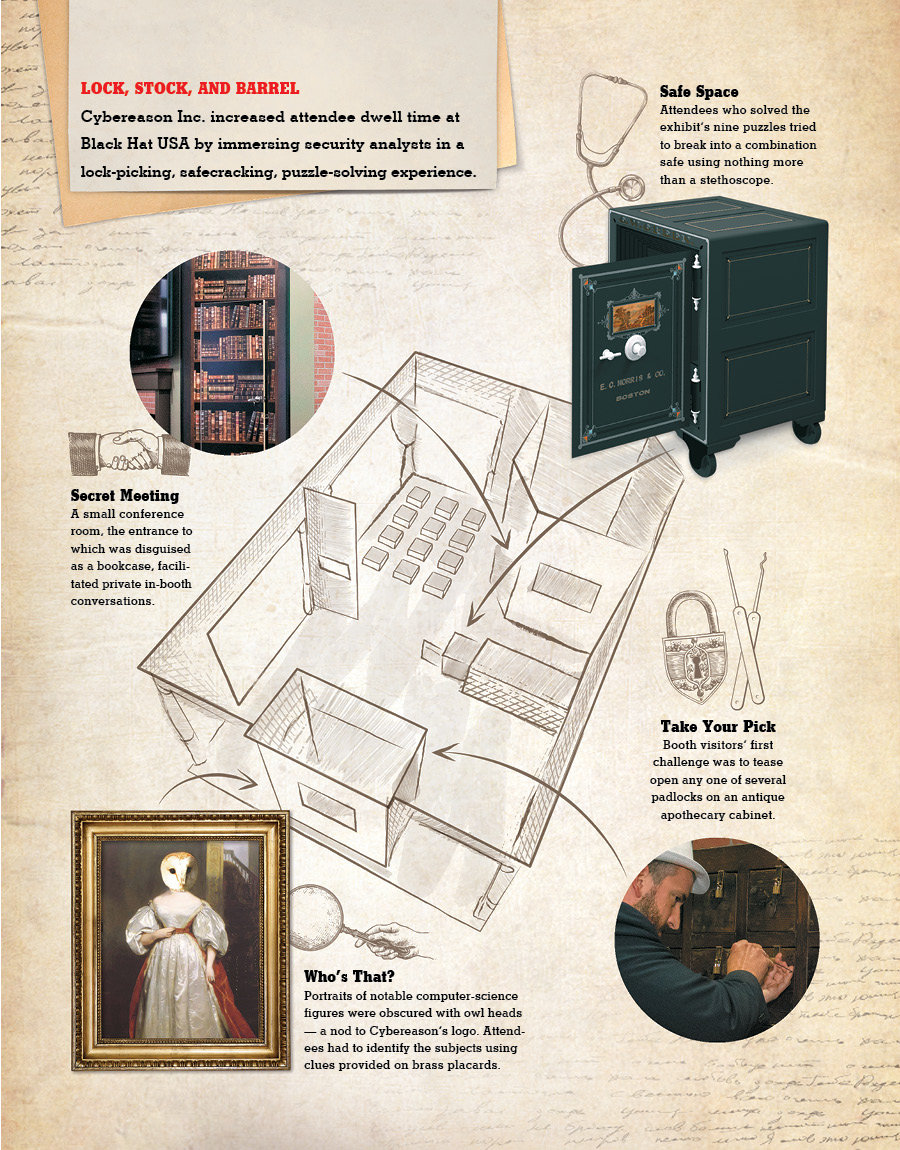
The 20-by-30-foot island loomed like a solemn Victorian residence more fit for 221B Baker Street than a Las Vegas exhibit hall filled with high-tech stands. Anchored by Moss Inc. fabric architecture, the booth featured faux brick accents, black velvet curtains, ornate crown molding, dark wood, and flatscreen fireplaces, all of which lent the exhibit a brooding and mysterious air. Inside the island, the Victorian decor continued with period artwork on the walls, an antique apothecary cabinet, a weathered iron safe, and a wooden bar.
Once attendees were waiting their turn at a three-pin padlock, staffers elaborated on the rest of the enigmatic booth. The puzzle cards featured checkboxes for the nine puzzles visitors would find throughout the exhibit, the first of which was the apothecary lock-pick challenge. Simply for completing any one of the nine challenges and allowing a staffer to scan their badges, attendees would receive a Cybereason T-shirt that read "I went to North Korea and all I got was attribution," an inside joke among hackers and security analysts that would come into play in an upcoming puzzle. However, any visitor that successfully completed all of the challenges earned a chance at the toughest test of all: busting into the combination safe with only the aid of a stethoscope and making off with the unknown contents.
With the help of nothing more than a tension wrench and an assortment of picks and rakes from an available lock-pick kit, analysts started breaking into the apothecary cabinet. The results indicated that Cybereason both rightly homed in on analysts' interests and greatly underestimated their skills. Nearly every visitor successfully picked his or her given lock – most with uncanny ease – so midway through the show, staffers swapped the three-pin locks for more challenging models in an attempt to slow them down.
After completing their first challenge, attendees fanned out to solve the eight remaining mysteries. Those puzzles comprised eight era-specific prints hanging on the inside and outside walls of the exhibit. Half were portraits of noted computer-science figures ranging from Alan Turing, best remembered for decoding Nazi Germany's Enigma machine during World War II, to Grace Hopper, the rear admiral in the U.S. Navy who helped develop Cobol, the computer programming language still in use today. However, each figure's face had been replaced by an owl's head, an addition that hid the subject's identity and referenced Cybereason's illustrated avian logo.
Below each portrait, a brass placard contained a clue as to the identity of the disfigured subject. For instance, below the portrait of a woman clad in a voluminous white and red dress, the clue read "I'm a Countess and daughter of a Lord, but I did not while away at home bored. The first algorithm I created; more than a century later my accomplishments were finally celebrated." The riddle was designed to lead puzzle solvers to Ada Lovelace, a 19th-century English mathematician and writer most famous for creating the world's first algorithm that was designed to operate with Charles Babbage's (the fourth subject of the portrait puzzles) mechanical general-purpose computer.

At any point in the process, booth visitors could admit defeat, present their cards to a staffer, have their badges scanned, and, assuming they completed at least one puzzle, receive a T-shirt. The visitors that persevered and solved all nine challenges took their crack at the antique safe. Of course, using nothing other than a stethoscope to release a combination lock requires more finesse than a typical smash-and-grab heist. Many tried, and the only two that succeed each made off with a Hak5 Field Kit, the digital equivalent of a lock-pick set.
Everything Clicks
Before Black Hat locked its doors, Cybereason knew it had made out like a bandit – and it had the loot to prove it. Tapping into attendees' interests helped the company surpass its lead goal by 30 percent, and staffers distributed more than 3,000 T-shirts, meaning several thousand showgoers completed at least one of the booth's puzzles. On top of that, the series of challenges significantly increased dwell time, enabling staffers to offer deeper dives into the company's software solutions through presentations, demos, and private conferences, all of which helped it exceed its in-booth meeting goal by 20 percent.
Cybereason's success just goes to show that sometimes cracking the code to an undeniably efficacious exhibiting strategy is less about bombarding booth visitors with technological wizardry and more about hacking into their hearts and minds. It's elementary, my dear Watson. E


Marketplace

- Audiovisual Equipment
- Convention Centers
- Event Design and Production
- Exhibit Fabrication
- Exhibit Producers
- Exhibit Rental
- Experiential Agency
- Flooring
- Graphics
- International Exhibit Producers
- Kiosks
- Lead Retrieval
- Modular Exhibit Systems
- Portable Display Systems
- Shipping and Transportation
- All Companies
3048R Sales and Marketing Alignment: How to Get ‑ and Stay ‑ on the Same Page
Feb. 10, 2026
3011R How to Grow Your Brand: Incorporating Brand Marketing into Your Exhibit Program
Feb. 19, 2026
4101R Boost Up: Promote Yourself from Service Provider to Strategic Business Partner
Mar. 3, 2026
6020R The @show Experience: Understand the Essentials of Exhibit Design
Mar. 10, 2026
7058R Authors Executive Series: Thrive Under Deadlines: Strategies for Success
All Sessions >>