management
How to Quantify Your Target Audience
After my company missed its on-floor sales goals at a show for two years running, I decided to learn more about the event's audience. What I discovered changed my whole mindset, as I realized we were truly targeting just 1 percent of the show's 22,000 attendees. This new awareness resulted in my team redefining our goals and objectives, asking for a cut in our show budget, and more than doubling our return on investment. By Marc Crosier

Numbers don't lie – but they can obscure the truth. And taking the gross number of attendees at face value is a misstep too many exhibitors make. A few years ago, a medical-supply company that specializes in eye-care equipment hired me to be the event manager for its trade shows. As anyone in a new position should, I took some time to figure out what the company was doing at its shows and why. One immediate point of concern was that for two years in a row my new employer had failed to meet its on-floor sales goals and get a satisfactory return on investment at an important optometry show that regularly drew more than 20,000 attendees. Being tasked with overseeing this program, I felt I needed to pinpoint the problem and come up with a course correction.
 1 Request Information From Show Management
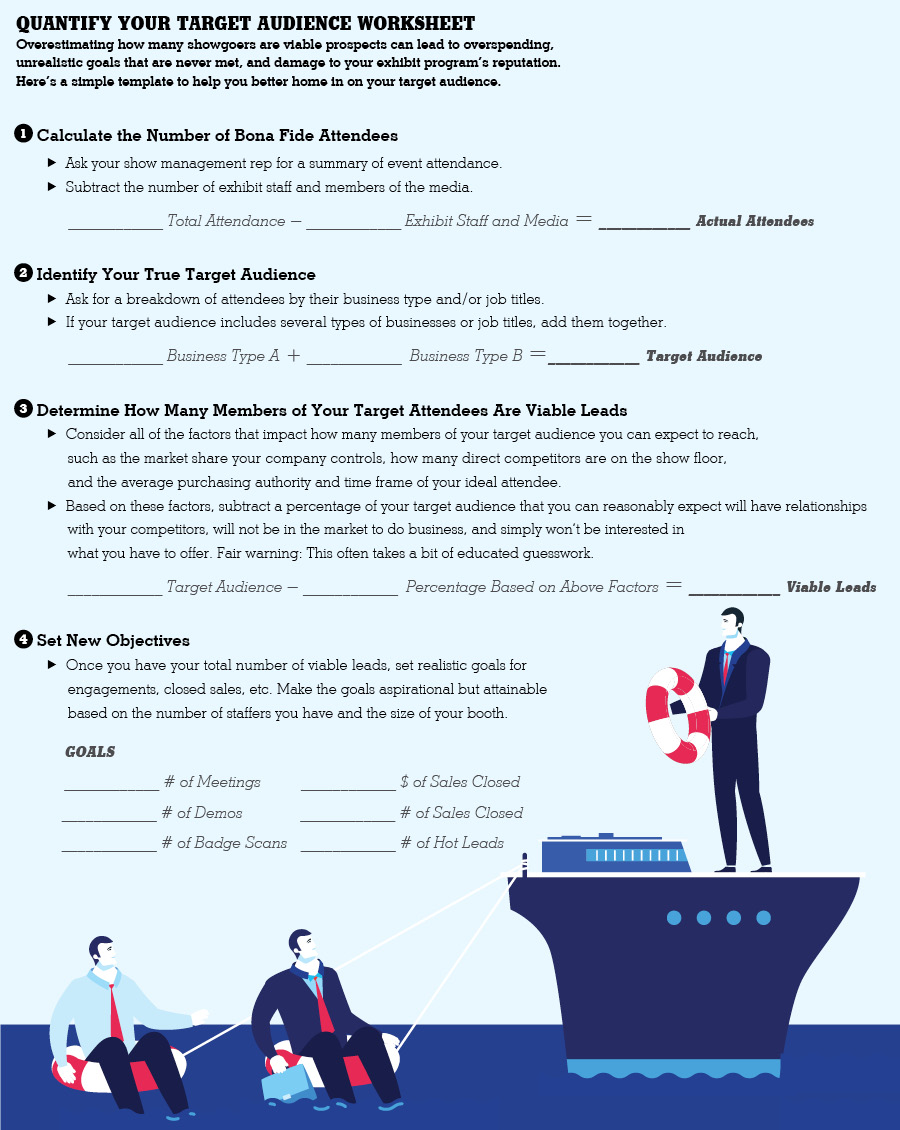
I had an inkling that our challenges were rooted in overestimating the number of attendees that we were targeting. So I reached out to our association, asked if it could help me understand who attended the event, and received the audited attendee analysis seen here. About 7,200 of the 22,000 showgoers were exhibitor staff and media, which left about 15,000 nonexhibiting attendees. That's still a massive number and nowhere near our true target audience, but I was making headway by narrowing the funnel by roughly 30 percent.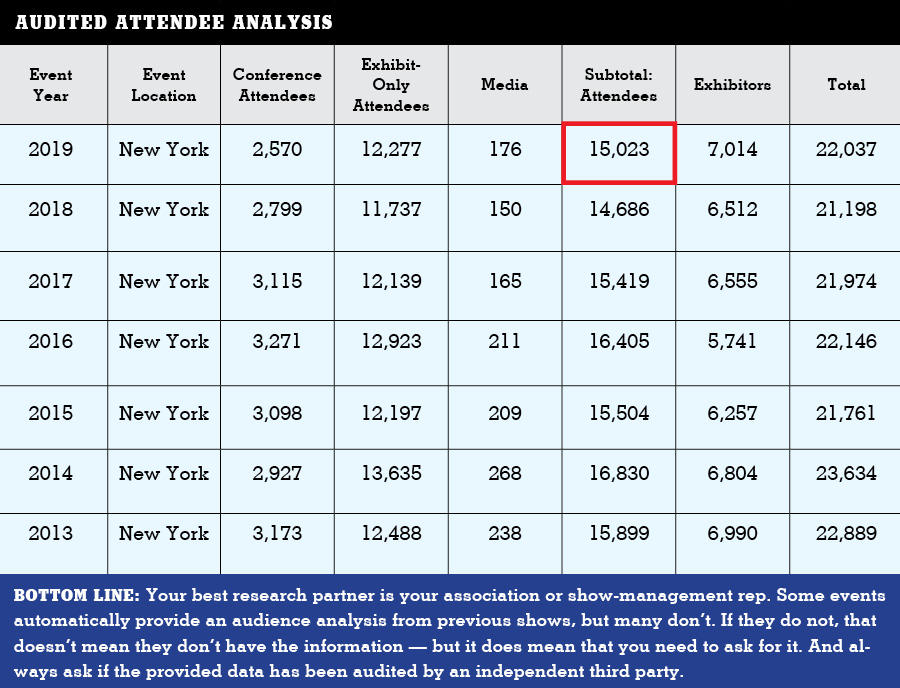 2 Identify Which Attendees Align With Your Business
Now I knew I was fishing in a pond stocked with 15,000 nonexhibiting attendees, but I still didn't know much about them. So I reached back out to my contact to see if I could get a clearer picture of just who was walking the show floor. The association sent a list of attendees from the previous year broken down by the type of busi- ness they were in. The data showed that the vast majority of visitors were retailers or involved in other practices that disqualified them from being in our target audience. Our key buyers at the show are ophthalmologists, of which there are about 1,000 – or less than 7 percent of the total attendance.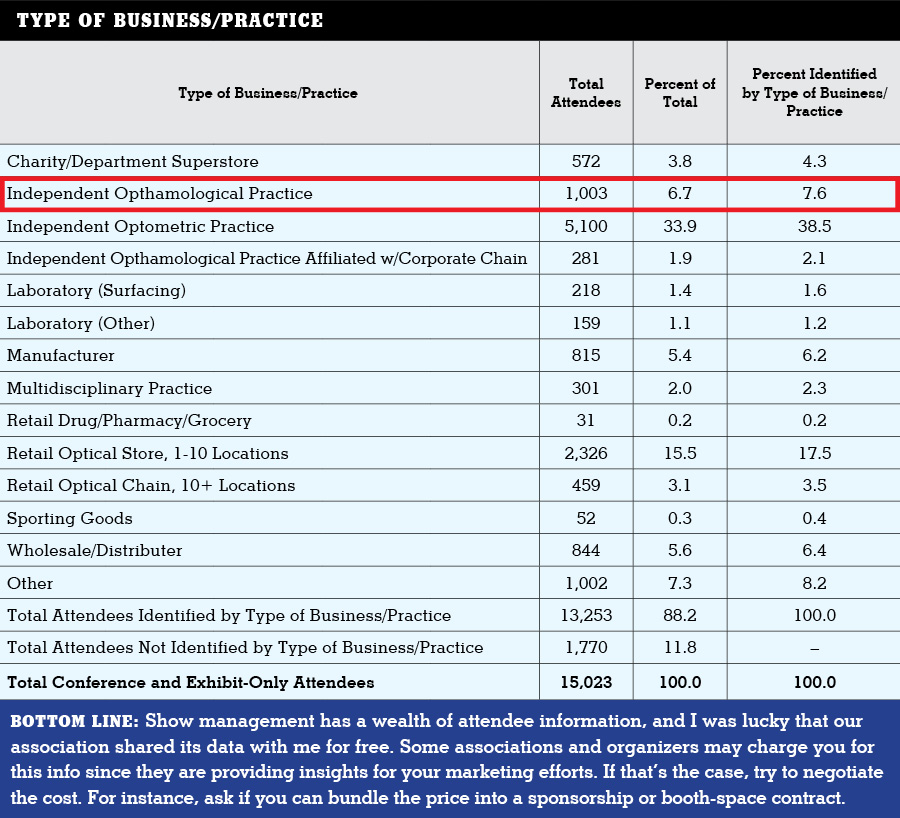 3 Set Realistic Expectations
Now that I had a grasp on how many actual prospects would be at the event, I began setting more realistic goals for just how many we could expect to reach. Based on my experience, I figured that half of the 1,000 ophthalmologists wouldn't be in the market to purchase goods within the next 30 days or simply wouldn't be interested in our product, leaving me with 500 candidates. Then I cut that number in half again because we were one of six exhibitors competing for the same audience, and it was safe to assume that a good chunk of those prospects either had relationships with our competitors or would be visiting – and possibly inking deals – with them. By my rough math, the 22,000 "prospects" the association told me I had were now winnowed down to a mere 250, i.e., about 1 percent of the total show attendance.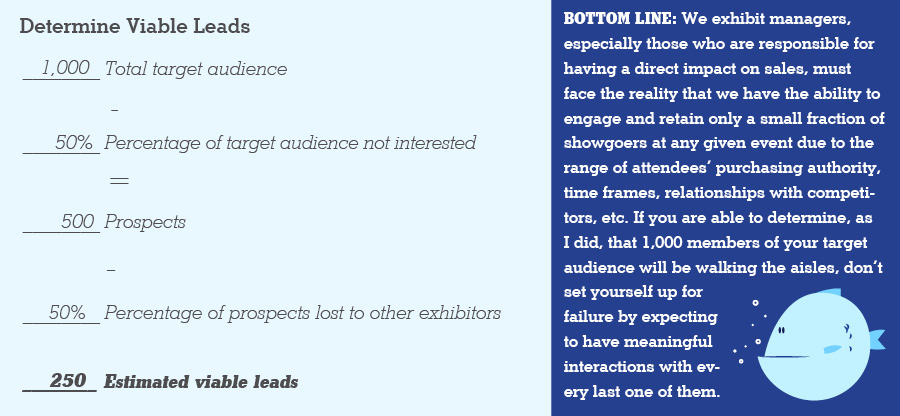 4 Rethink Your Investment and Objectives
Historically, our presence at this show comprised a 20-by-30-foot booth with a budget of almost $150,000. Staffers took orders in the exhibit, and our on-site sales goal was in the neighborhood of $1 million. Since our products' average price tag is in the low six figures, we had to close nearly 10 sales at the show to reach that target – which, as I said, hadn't happened in two years. And seeing as how we were actually fishing in a pond of 250 instead of an assumed ocean of 22,000, I wasn't too surprised the company was missing its million-dollar mark. So I went to my stakeholders, presented my findings and figures, and recommended downsizing to a 10-by-20-foot space, sending three staffers instead of the usual six to eight, and setting the more realistic objectives of netting 12 quality leads and landing one deal on the show floor.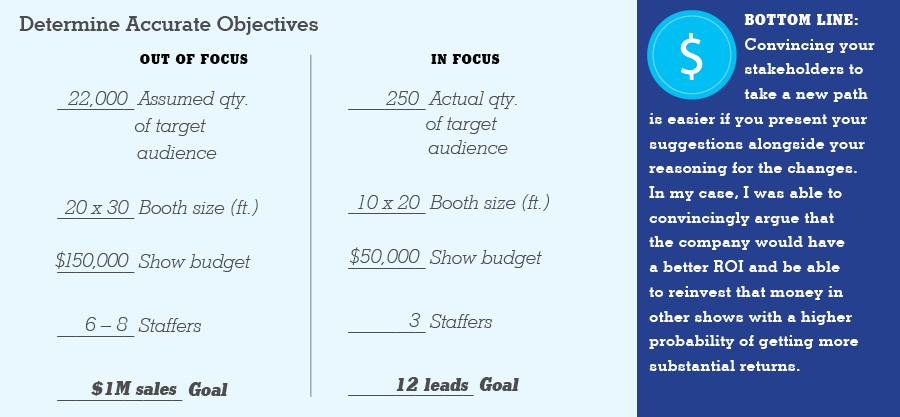 5 Find Your Fit
The process of quantifying your true target audience takes time and effort, so it may not be feasible for you to complete this task for every event on your calendar (exhibit managers just don't have that kind of time with all the other tasks on our plate), so I suggest starting with one or two of your key or troublesome shows. I bet you'll find the payoff and the potential savings are well worth the effort.My company likely would not have implemented these changes if I hadn't homed in on how much – or little – of our target audience was actually present at the show. But reevaluating our approach led to us trimming our investment in this show by $100,000, more than doubling our ROI, and, much to my delight, achieving our sales target. Yes, the goal was more modest, but when you factor in the reduced investment, we still pleased our stakeholders. Even better, we reallocated our six-figure savings to other events where there were bigger fish to reel in. E
After crunching the numbers and poring over the attendee data, I found that we were casting too wide a net for too few fish, i.e., we weren't correctly quantifying our target audience and were overspending at a show without enough potential revenue to hit our targets. As a result, I suggested to my leadership that we rethink our expectations, reduce our exhibit's footprint, and reallocate the savings to an event where the money would be used more effectively. Here, I'll explain how I went about quantifying our target audience and, in turn, set goals and objectives that reflected reality.
I had an inkling that our challenges were rooted in overestimating the number of attendees that we were targeting. So I reached out to our association, asked if it could help me understand who attended the event, and received the audited attendee analysis seen here. About 7,200 of the 22,000 showgoers were exhibitor staff and media, which left about 15,000 nonexhibiting attendees. That's still a massive number and nowhere near our true target audience, but I was making headway by narrowing the funnel by roughly 30 percent.
Now I knew I was fishing in a pond stocked with 15,000 nonexhibiting attendees, but I still didn't know much about them. So I reached back out to my contact to see if I could get a clearer picture of just who was walking the show floor. The association sent a list of attendees from the previous year broken down by the type of busi- ness they were in. The data showed that the vast majority of visitors were retailers or involved in other practices that disqualified them from being in our target audience. Our key buyers at the show are ophthalmologists, of which there are about 1,000 – or less than 7 percent of the total attendance.
Now that I had a grasp on how many actual prospects would be at the event, I began setting more realistic goals for just how many we could expect to reach. Based on my experience, I figured that half of the 1,000 ophthalmologists wouldn't be in the market to purchase goods within the next 30 days or simply wouldn't be interested in our product, leaving me with 500 candidates. Then I cut that number in half again because we were one of six exhibitors competing for the same audience, and it was safe to assume that a good chunk of those prospects either had relationships with our competitors or would be visiting – and possibly inking deals – with them. By my rough math, the 22,000 "prospects" the association told me I had were now winnowed down to a mere 250, i.e., about 1 percent of the total show attendance.
Historically, our presence at this show comprised a 20-by-30-foot booth with a budget of almost $150,000. Staffers took orders in the exhibit, and our on-site sales goal was in the neighborhood of $1 million. Since our products' average price tag is in the low six figures, we had to close nearly 10 sales at the show to reach that target – which, as I said, hadn't happened in two years. And seeing as how we were actually fishing in a pond of 250 instead of an assumed ocean of 22,000, I wasn't too surprised the company was missing its million-dollar mark. So I went to my stakeholders, presented my findings and figures, and recommended downsizing to a 10-by-20-foot space, sending three staffers instead of the usual six to eight, and setting the more realistic objectives of netting 12 quality leads and landing one deal on the show floor.
The process of quantifying your true target audience takes time and effort, so it may not be feasible for you to complete this task for every event on your calendar (exhibit managers just don't have that kind of time with all the other tasks on our plate), so I suggest starting with one or two of your key or troublesome shows. I bet you'll find the payoff and the potential savings are well worth the effort.My company likely would not have implemented these changes if I hadn't homed in on how much – or little – of our target audience was actually present at the show. But reevaluating our approach led to us trimming our investment in this show by $100,000, more than doubling our ROI, and, much to my delight, achieving our sales target. Yes, the goal was more modest, but when you factor in the reduced investment, we still pleased our stakeholders. Even better, we reallocated our six-figure savings to other events where there were bigger fish to reel in. E


Magazine Topics
Marketplace

- Audiovisual Equipment
- Convention Centers
- Event Design and Production
- Exhibit Fabrication
- Exhibit Producers
- Exhibit Rental
- Experiential Agency
- Flooring
- Graphics
- International Exhibit Producers
- Kiosks
- Lead Retrieval
- Modular Exhibit Systems
- Portable Display Systems
- Shipping and Transportation
- All Companies
eTrak Online Sessions
Feb. 5, 2026
3048R Sales and Marketing Alignment: How to Get ‑ and Stay ‑ on the Same Page
Feb. 10, 2026
3011R How to Grow Your Brand: Incorporating Brand Marketing into Your Exhibit Program
Feb. 19, 2026
4101R Boost Up: Promote Yourself from Service Provider to Strategic Business Partner
Mar. 3, 2026
6020R The @show Experience: Understand the Essentials of Exhibit Design
Mar. 10, 2026
7058R Authors Executive Series: Thrive Under Deadlines: Strategies for Success
All Sessions >>
3048R Sales and Marketing Alignment: How to Get ‑ and Stay ‑ on the Same Page
Feb. 10, 2026
3011R How to Grow Your Brand: Incorporating Brand Marketing into Your Exhibit Program
Feb. 19, 2026
4101R Boost Up: Promote Yourself from Service Provider to Strategic Business Partner
Mar. 3, 2026
6020R The @show Experience: Understand the Essentials of Exhibit Design
Mar. 10, 2026
7058R Authors Executive Series: Thrive Under Deadlines: Strategies for Success
All Sessions >>